
Manufacturers replacing repetitive manual work
Factories that want robots to take over assembly, inspection support, part feeding, or other repeatable line tasks.
Factory Work Automation
Turn skilled factory line-worker knowledge into data that robots can learn from.
Capture how people pick parts, use tools, check workpieces, and keep timing on the line, then structure that knowledge for humanoid robot learning and future labor replacement.
Definition
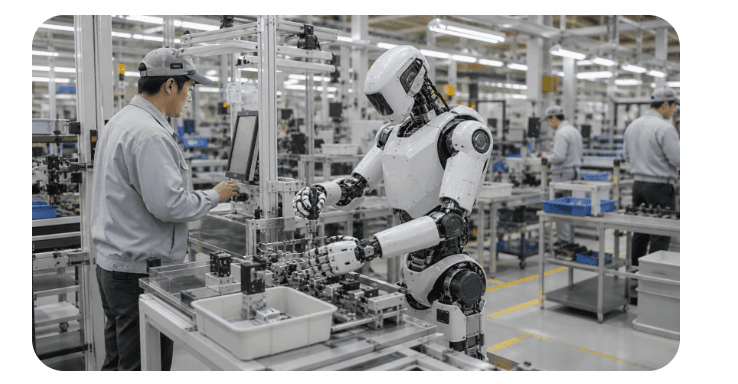
Robot Action Data is a system for turning human factory work into robot training material. It reads operation videos and organizes the sequence, timing, hand movement, tool use, and workpiece handling behind skilled line work. The goal is to preserve human know-how and move repeatable manual work toward robot execution.
Factories that want robots to take over assembly, inspection support, part feeding, or other repeatable line tasks.
Teams that need to capture expert motions, checks, and tool handling before that knowledge disappears.
Teams that want to start with existing videos before investing in larger hardware or line changes.
Workflow
Capture hands, tools, workpieces, and workstation context using a phone or action camera.
Break the work into moments such as picking a part, aligning it, applying a tool, and checking the result.
Organize hand position, posture, tools, parts, timing, and workpiece state across the timeline.
Export the structured results for robot learning, motion design, and replacement-feasibility review.
Capabilities
Turn tacit worker habits, checks, and tool motions into reviewable data.
Separate stable repeatable work from steps that still need human judgment.
Use the same action structure to review timing, sequence, position, and failure points.
Begin with normal operation videos, then expand into fixed cameras and production-system links as needed.
Practical use
The system turns human line work into practical material for robot training and automation planning.
FAQ
The first step is not replacing an entire line at once. We identify repeatable, stable tasks from human work data, then use that data to plan robot learning and staged replacement.
Part picking, simple assembly, tool application, handling steps before or after inspection, and other repeated line tasks are good starting points.
No. We can start from phone or action-camera videos, then expand to fixed cameras or production-system integration when the target task is clear.
We can review real line-work videos with you and identify which motions, tools, parts, and checks should become robot learning data.